
Why do people resist change?
The Business Problem
Turn resistance into support for your initiatives
Strategic decisions are those that set the goals of an organization and allocate resources accordingly. By definition, new strategic initiatives call for change, whether explicitly or implicitly. People may openly resist or subconsciously avoid a change, especially when the consequences are unknown. Being weary of change is normal.
Research shows that resistance to change can be reversed when the possible gains are significant: in the range of 50–150% better than the status quo.
This subject was first documented in the 1970s through pioneering research by Kahneman, Tversky, and their peers, and investigated further by a plethora of research since.
The core discovery is that people make choices based on our own assessments of what we can gain or lose as a result of a change. When we fear losing what we have already gained, we avoid participating for as long as we can. On a fundamental level, we want to feel safe because we psychologically prefer certainties over possibilities.
Leaders should take into account that some people will resist simply because they are risk averse. The larger question is, how can you trigger more support for a new strategic initiative?
Use Behavior Science to Identify Triggers of Support
As of the 2010s, research has developed principles with three foundational bases. First, people use reference points and prefer to simplify their mental evaluations into “rules of thumb”. Second, people are willing to choose future opportunities that are significant enough, instead of staying with a current solution that has certainty. Third, people tend to differentiate options based on perceived differences.
So here is the trigger that leaders can use: if a change provides an opportunity to increase a gain significantly, people can be willing to make the change without requiring certainty or an absolute understanding of the potential outcome.
Such positive gains, or possibilities that may be perceived in a positive manner, must truly matter to the people though. The effectiveness of this trigger hinges upon how they subjectively gauge the potential of the gain in a rule-of-thumb fashion. To this end, how the initiative is communicated matters directly and fundamentally.
Here is an example instrument for use to discover potential triggers during strategy validation. The “initiative” could be due to M&A, a new technology adoption, business process change, or a leadership change.
Discover Reasons Of Resistance To Change
Asking the following question using Survature‘s AnswerCloud can identify the reasons people are resistant to change.
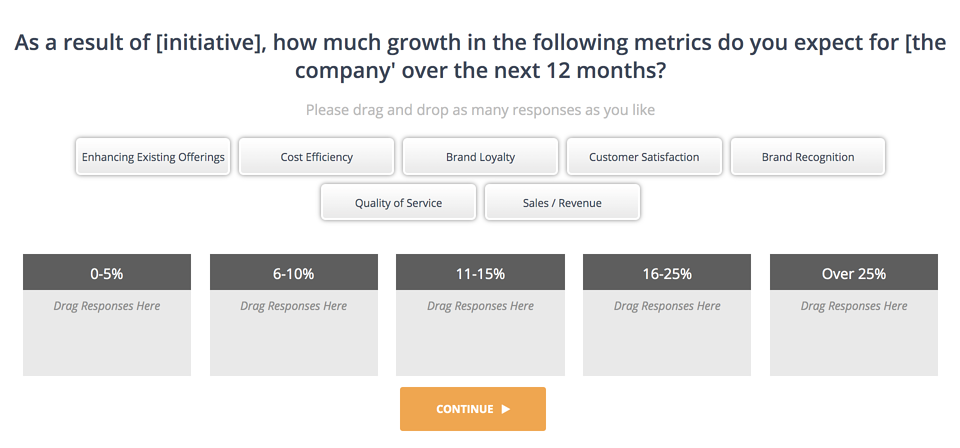
This Survature instrument dissects the problem along two dimensions.
First, the same as all AnswerCloud questions, this question reveals what kinds of gain matter the most to different people: who are from different functional areas, in different career stages, and most importantly, under different incentive structures.
Second, reference points are embedded into the scales of this instrument. This example shows an organization that is used to expecting 10% growth. So if an initiative can boost a metric beyond 15% growth, and that metric happens to be at the top of our minds, then that metric can serve as a trigger for support. Whereas, when results don‘t show any metrics that people care about can significantly exceed the status quo, the likelihood of resistance to such change will be significant.
Knowing this information can help guide many strategy level considerations, whether it‘s an issue of reallocating resources, restructuring incentives or reframing communications. The “10%” growth metric used in this template is just an example. This instrument is also fully customizable to suit different needs.
Please also note - while you may be tempted to include all of the established KPIs in this investigation, you should prioritize tangible metrics used in people’s inventive and compensation structures, so that you can correlate motives with actions.
Survature‘s AnswerCloud automatically produces interactive charts
The horizontal axis shows what participants chose as an item‘s growth potential. The vertical axis shows how much the items really matter to them.

This example shows what kind of results you may receive with the Survature instrument. For this example, there are only two items (G and E) that mattered to the participants, and both are better than the status quo but not enough to trigger support for the initiative. Obviously. such insights can provide focus and clarity for any of the ensuing efforts on strategy validation, communication, and execution.