
Find Risks Early During The Innovation Process
The Business Problem
How to evaluate, select, and develop innovation ideas
Big breakthroughs happen when “what is suddenly possible” meets “what is desperately needed”. Breakthroughs do not require radical new ideas. Incremental innovations can result in breakthroughs too. The magic, and also the art, is in how ideas are realized through evaluation and iteration. Unfortunately, using a formal process does not guarantee success, because formal processes are based on “known” metrics, which by nature penalize things that are different. On the other hand, informal evaluation cannot guarantee success either, because it suffers from systemic human cognitive biases, such as confirmation biases, anchoring effects, hindsight biases, etc. So far, a reliable best practice for evaluating new ideas and innovations remains elusive despite considerable past research.
When evaluating and shaping innovation ideas, biases are prevalent and detrimental to results. Know your risks before the GO decision.
Whether you use Phase Gate (e.g. stage-gating) or Lean Startup methodologies, you will need to go through cycles of assess-fix-build or build-measure-learn, where instant feedback can turn moments of “not good enough” into real progress. Thankfully, when your team has conflicting ideas and viewpoints, there are common sense steps your team can take: meaningful iteration and feedback, spirit of cooperation, and information sharing. In this regard, when information changes, people's position can change. It is crucial to get better and better information throughout the innovation cycle so that risks can be discovered and addressed continuously.
There are many important questions about underlying risks, such as “are you providing a solution to a need that is actually desperate?”, “is the solution really feasible?”, and “are there insurmountable barriers for widespread adoption?” Unfortunately, information that can help answer those questions has been difficult to get because few previous tools can navigate past social and professional biases.
Use Science to Evaluate, Select, and Develop Innovation Ideas
Below is a detailed framework to weed out risks during the idea development stage. It includes two instruments: Instrument-A to get an internal perspective, and Instrument-B to get an external perspective. While each perspective can discover many risk factors, mis-alignments and gaps across those two perspectives can reveal even bigger risks. The design of this framework is based on latest advances in management science and product innovation management. Survature‘s behavior science instruments have made these science advances deployable and useable in a people-friendly manner.
- Title: Innovation Idea Evaluation
- Organizer: Company/Product Leaders
- Target Audience: Internal teams/employees, advisers/consultants, and targeted domain users/customers
- Instruments: Instrument-A for internal team, Instrument-B for each target segment of customers. Instrument-A and per-segment result of Instrument-B will be compared to diagnose mis-alignment and discovery fit
- Completion Time: Varied, 2-3 minutes per instrument
- Analysis Time: Instant (analytics generated automatically by Survature data analytics suite)
- Insight gained: Prioritized information on what‘s our aspiration, what do we play, how do we win, what do we need; and assessment information on technical feasibility, value proposition, and future business potential
- Nomenclature: In the plethora of literature from both industry and academic research, there is not an established and general framework that can define and distinguish terms such as “idea”, “concept”, and “opportunity” in ways that are useful in practice. Due to such fuzziness, you‘ll need to decide which term fits the best with your work. In the following, we use the term “idea” to describe the overall framework.
Instrument-A: The Internal Perspective
QUESTION A1
The Quality of Information Depends on the Quality of Network
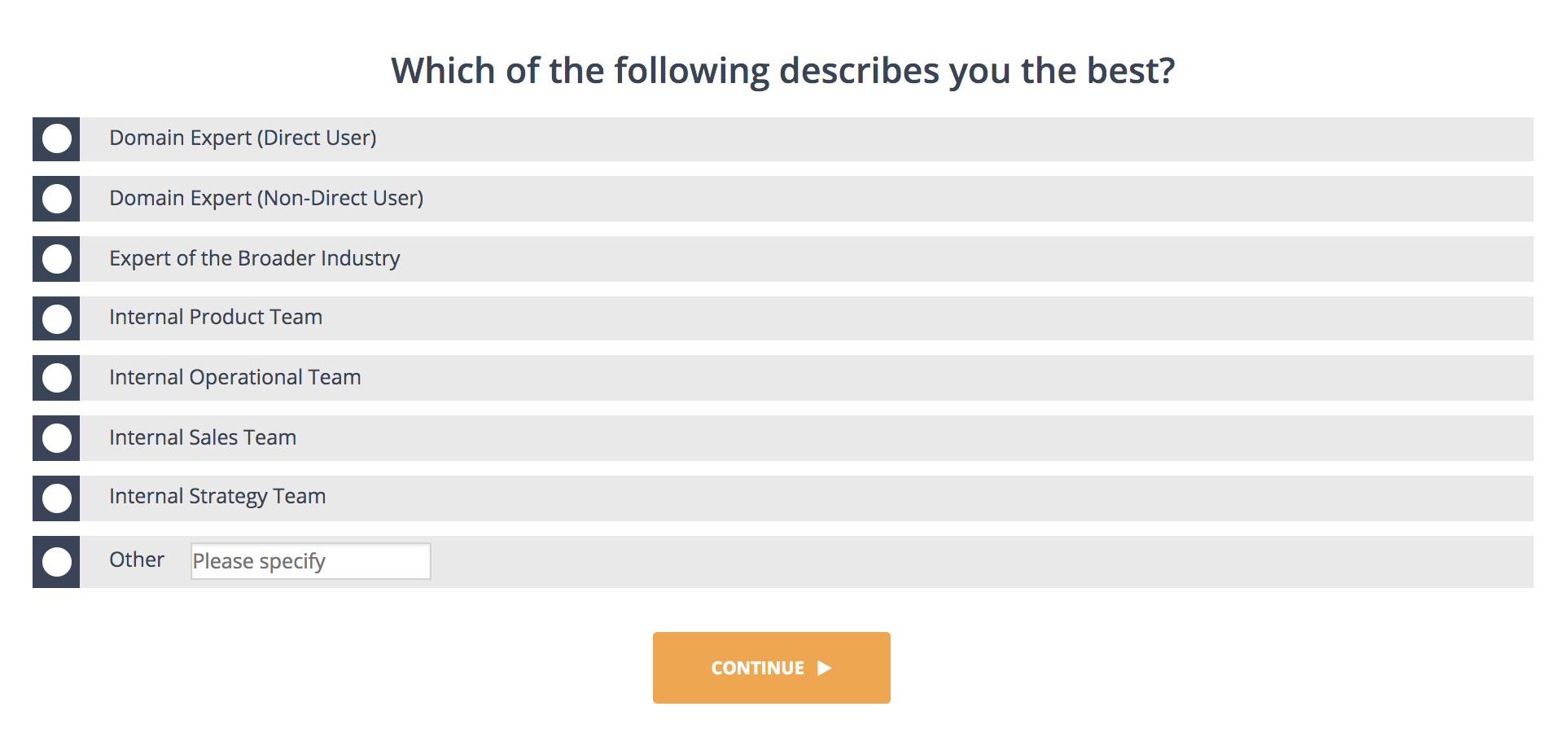
There are many internally discoverable risk factors when developing a new idea. Research has found that the originators of an idea suffer too much bias when evaluating the idea. It‘s best to involve a larger team as well as trusted external experts, advisors, and consultants. Maximizing diversity of perspectives in this stage is the best thing you can do to discover risks.
QUESTION A2 (Behavior enabled AnswerCloud™)
Find the Aspiration Hierarchy
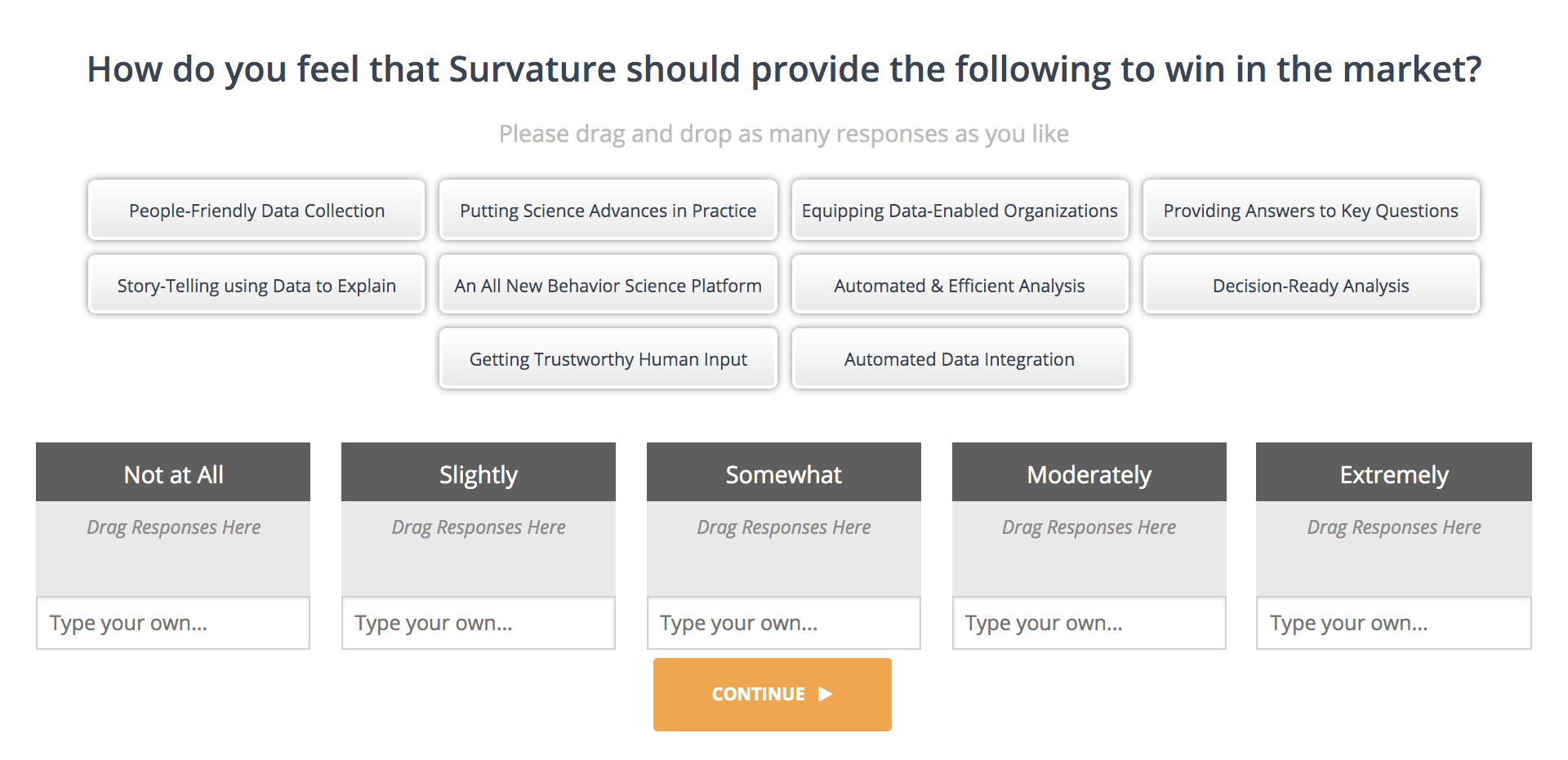
For product innovation and service innovation alike, there are significant aspirations that form the basis of the overall vision. It‘s hard to provide a realistic example without the full context. Here is a sample instrument to discover Survature‘s aspiration hierarchy. Please note that the hierarchy will look different just because people will come from different perspective. What‘s important is to discover whether your aspiration hierarchy aligns with your capability hierarchy (to be quantified using A3).
QUESTION A3 (Behavior enabled AnswerCloud™)
Gauge Capabilities to Manage Complex Risks
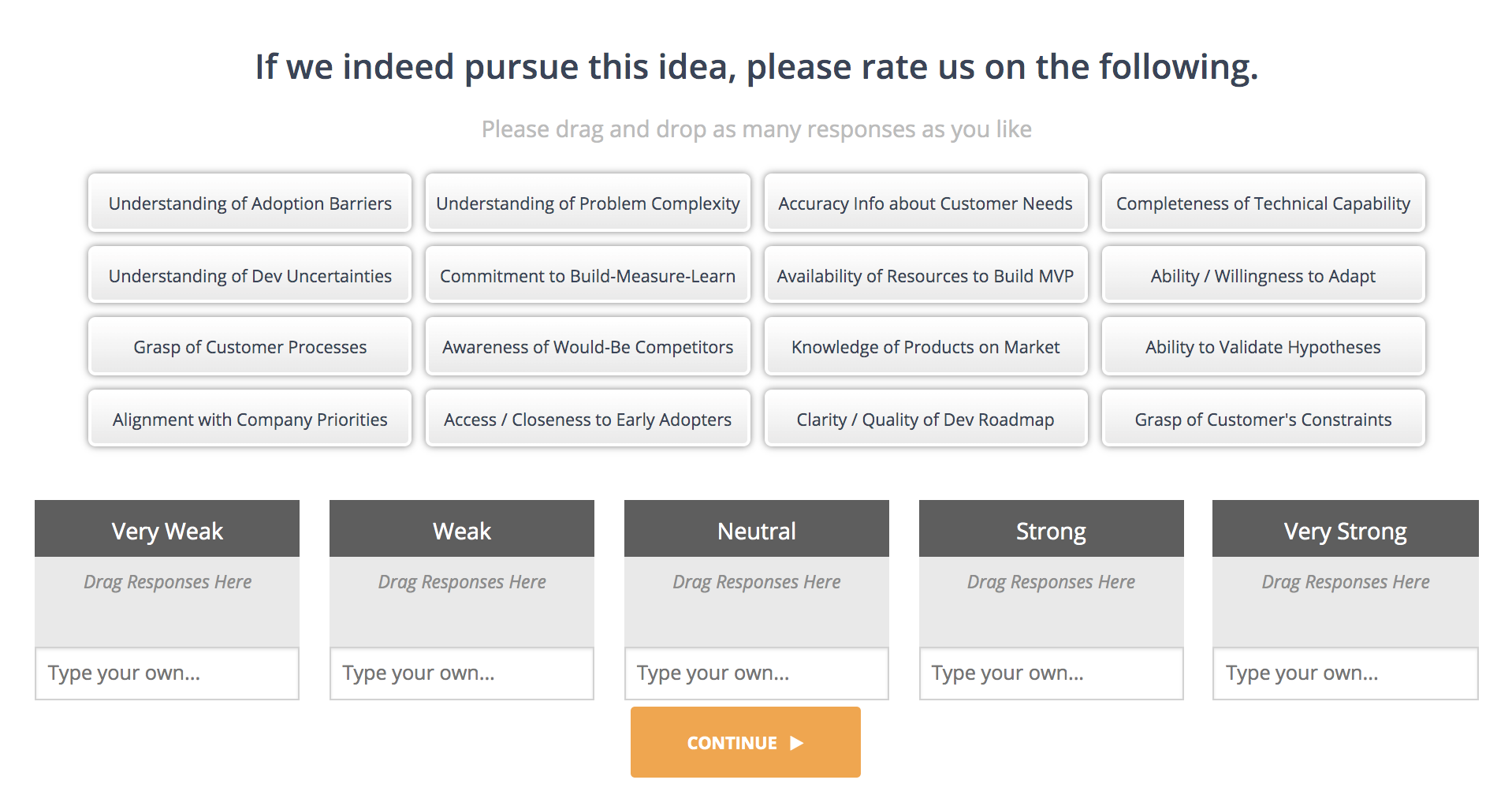
This instrument aims to assess the idea‘s potential when needing to mitigate a whole variety of internal risks. The risk categories are technical risks, strategy risks, and market risks. Comparing A2 and A3 will reveal aspiration-capability mis-alignments, so that the ensuing idea development cycles can address every mis-alignment. Depending on the setting, e.g. corporate vs. lean startup, some items in the AnswerCloud may be omitted. The outcome can help answer the strategic question - “How do we win?”
Instrument-B: The External Perspective
QUESTION B1 (Behavior enabled AnswerCloud™)
Customer Needs Hierarchy
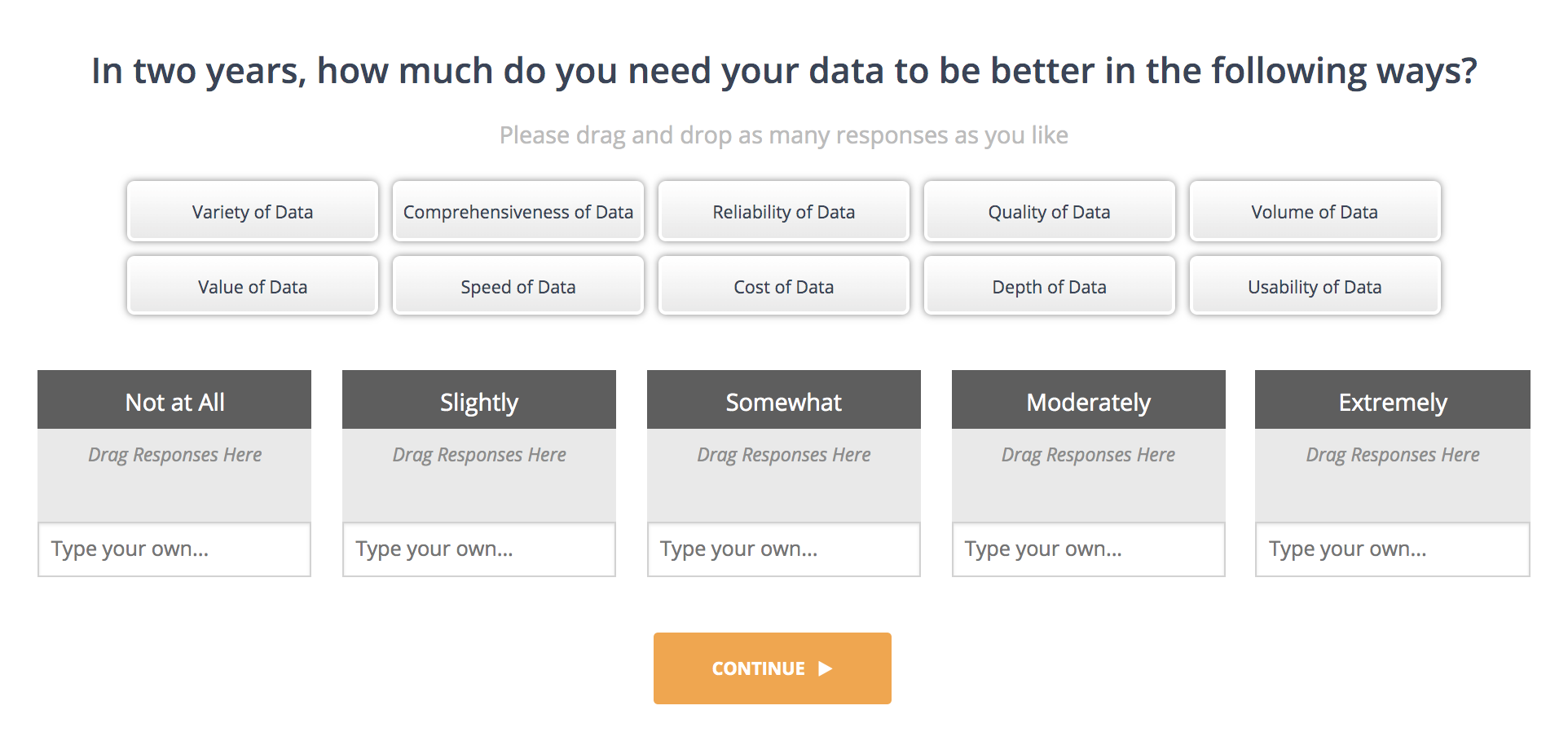
Only your customers know their true needs, worries, and constraints. No one else does. Regardless of how many years of experience you have working with them or selling to them. Overlooking this difference can have severe consequences down the road. Please note, “needs” alone cannot define pain points. Other important aspects include your customer‘s worries and constraints.
The alignment between your idea‘s aspiration hierarchy and your customer‘s hierarchy of pain points not only can help you validate product-customer fit, but also help you optimize your answer to the strategic question: “Where do we play?” Please consider B1-B3 together. The following still uses Survature for example.
QUESTION B2 (Behavior enabled AnswerCloud™)
Customer Risk Hierarchy
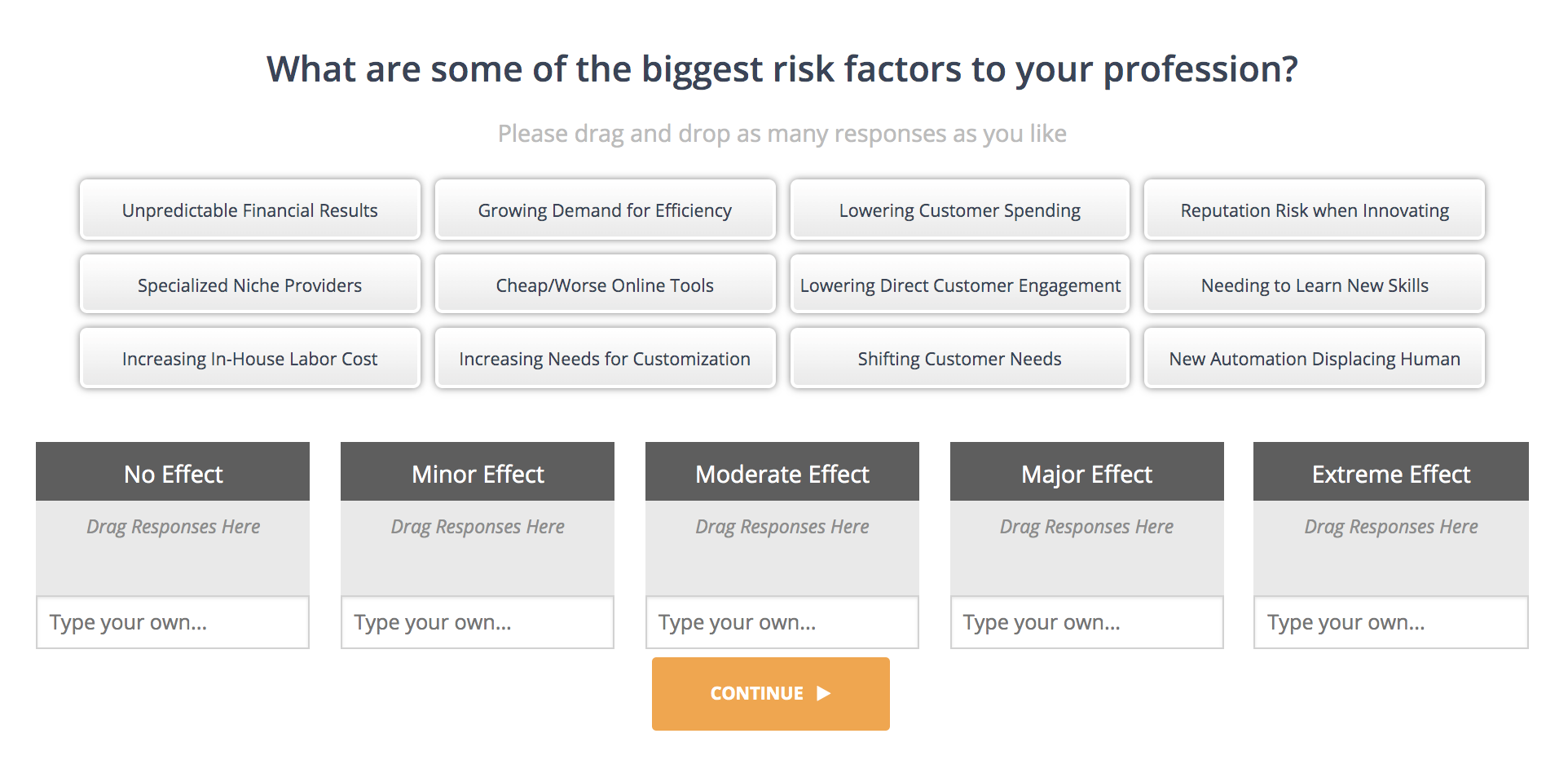
When an innovation increases any high-priority risks of the customer, there will be adoption barriers. In contrast, innovations that reduce the customer‘s high-priority risks will get adopted quickly. This information has not been widely used in the past because of lacking the right instrument. This Survature instrument has made such analysis possible.
QUESTION B3 (Behavior enabled AnswerCloud™)
Customer Constraint Hierarchy
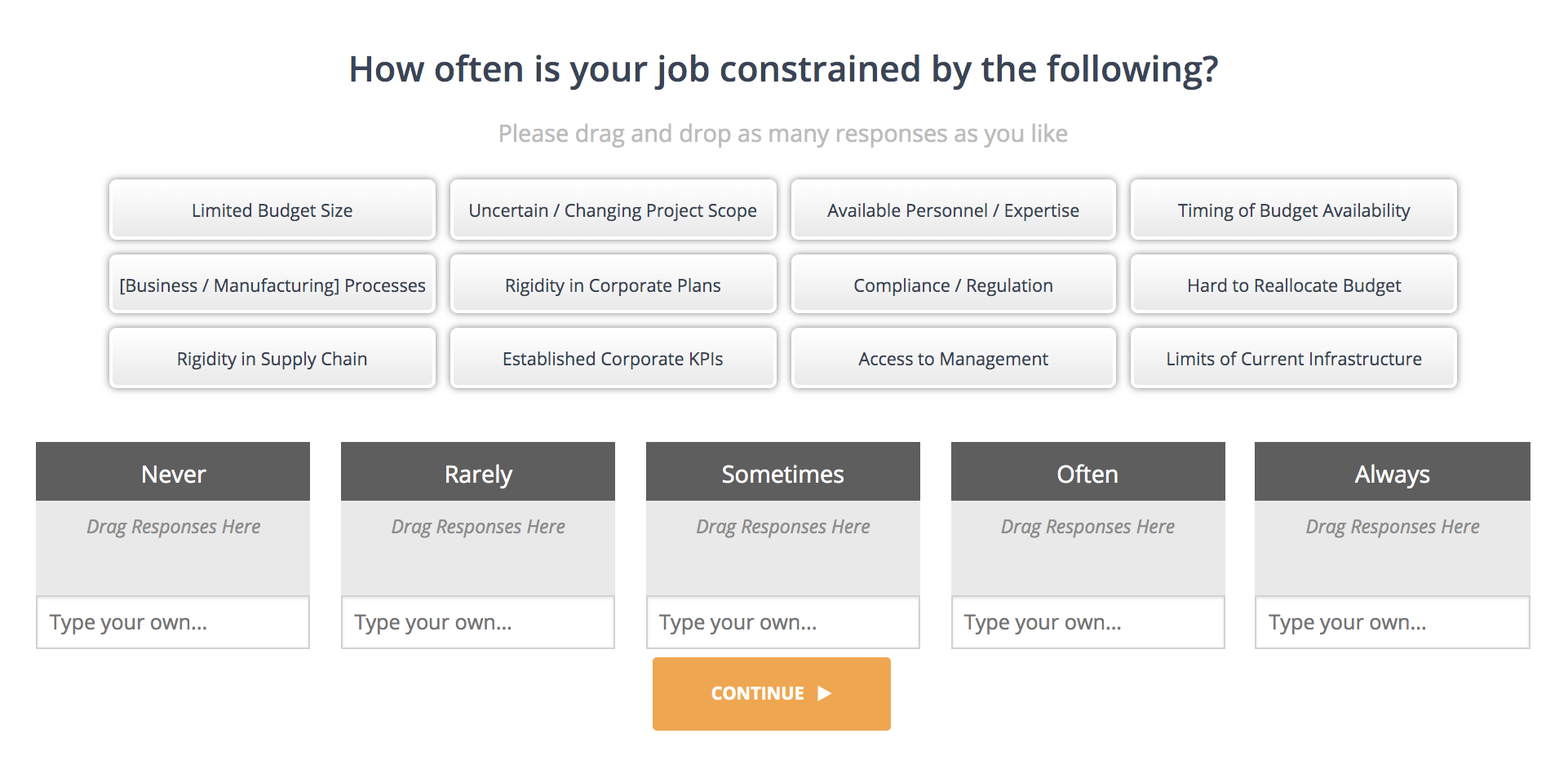
The customer‘s constraints are complex. Prioritized information about such constraints has a great value. This information can help innovators envision how a product is to be sold and used. More fundamentally, this information can reveal the likelihood of a new customer staying a long-term customer, which affects the innovation‘s total business potential.
QUESTION B4
Benchmarking the Window of Opportunity
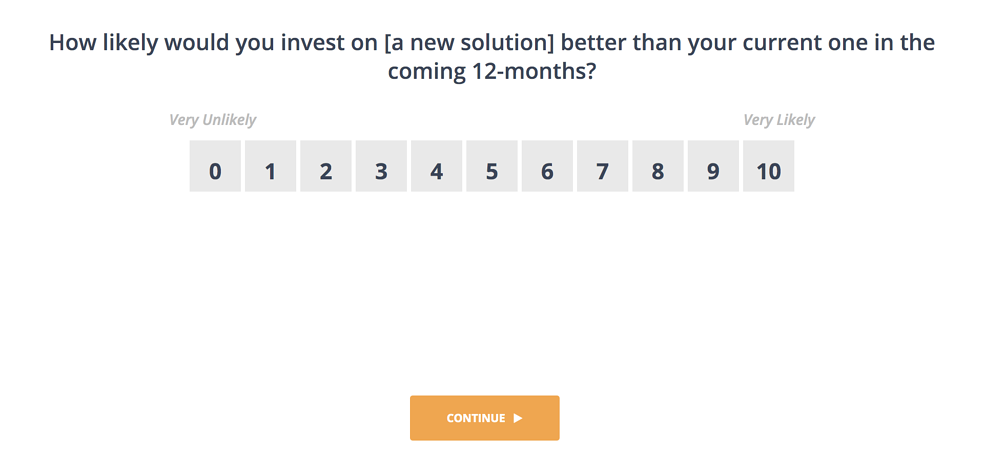
Last, this is to establish a basis to compare ease-of-entry across a variety of potential segments of target customers.
Instrument-A is easy to deploy, as long as your team is part of a growing network of people with diverse experiences, expertise, and insights.
Instrument-B is also easy to deploy. For example, if you are interested a particular segment of customers and happen to be at a conference with them, going around the coffee breaks outside their sessions with an iPad can get you enough data to make decisions in a day. Talking to people on LinkedIn and genuinely asking for help can get you enough data in a week.
Regardless of how an idea originated, don‘t sink 9-month‘s development investment to create an MVP and be forced to pivot then, because of mis-alignments that could have been discovered in a matter of days back during the ideation stage.
In the end, “if you build it, they will come” is a myth. It‘s not true in Silicon Valley (SV) nor anywhere else. Recent research on past SV success stories confirms that - be it with HP or Apple, their closeness to market intelligence and customer demands played a big part in the shaping of their early success.
Intuition and serendipity provide initial sparks. Evaluating, selecting, and developing those sparks into big breakthroughs is a risky process. Survature has created a framework to bring intuition and formal processes together so that leaders can find risks before the GO decision.
Click below to schedule a demo below for a complete tour of the Survature platform, including our automated analytics suite